

The Equilibrio Gazette
A brief buletin for building safe workspaces!
This weekly newsletter is your gateway to staying current on relevant laws (like POSH, POCSO, Transgender Persons Act, etc.) and the psychosocial intersections that impact the workplace.
25th September 2026 | Issue No. 152
Upcoming Events
Mark your calendars! In this section, we highlight an upcoming event you won't want to miss.
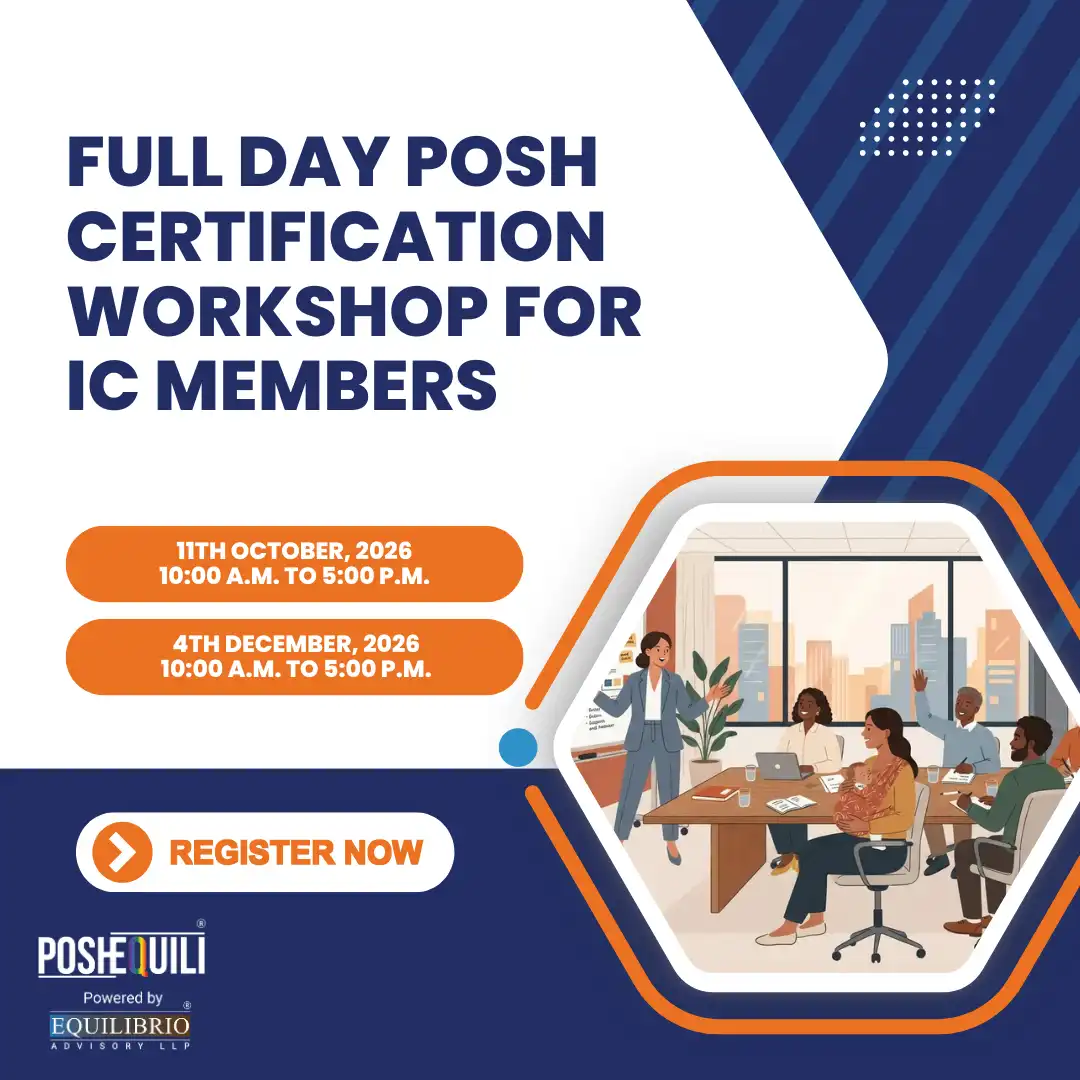
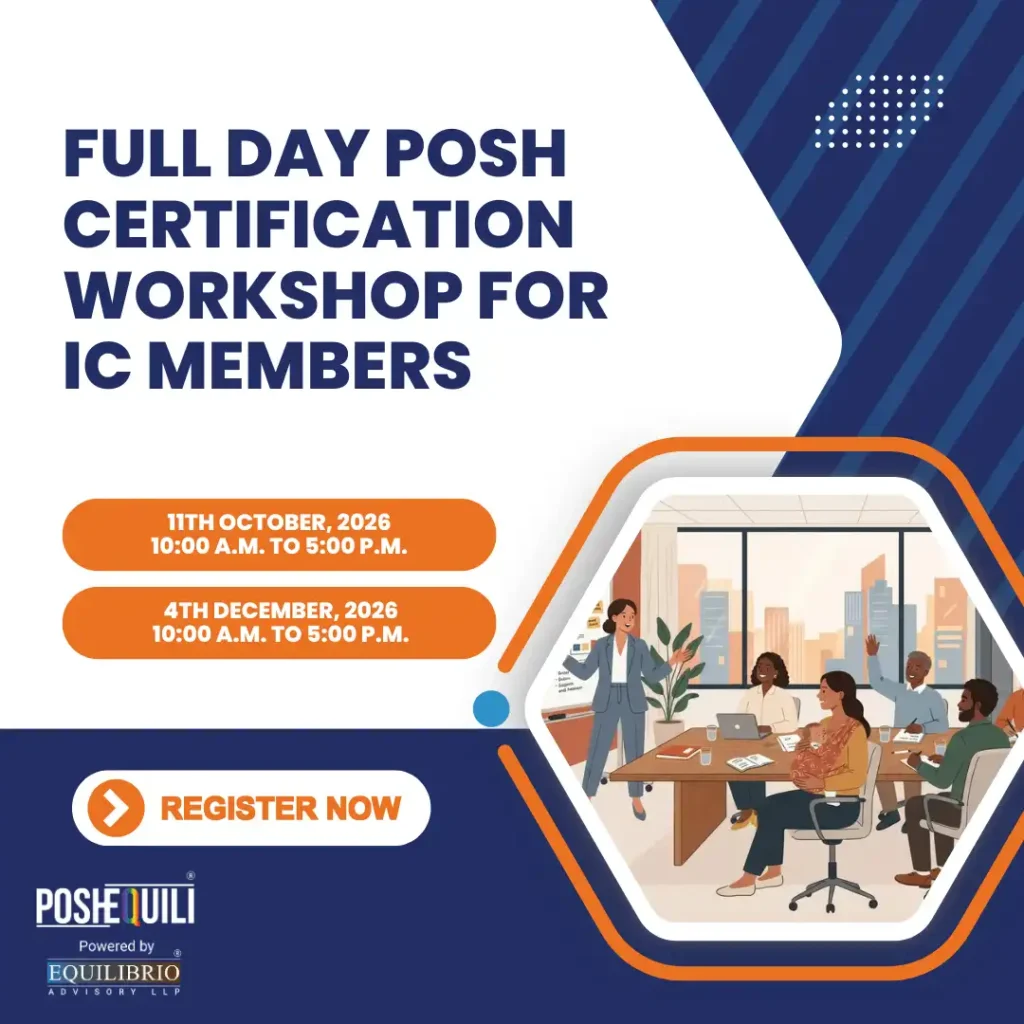
Looking to strengthen your professional expertise in POSH?
Our POSH Training for Internal Committee Members builds practical knowledge in handling complaints, documenting evidence, following due process, maintaining confidentiality, and understanding IC responsibilities under the law.
For IC members and professionals across HR, Legal, Compliance, Ethics and Mental Health.
In the Spotlight!
Explore ways to build your knowledge and capacity with our team of in-house experts!
This one’s to commemorate our recent offsite, first of it’s kind!!
Here’s to 10 years of showing up for the work and for each other.
This one was for us, for the paths we’ve walked and the relationships we’ve built event through screens.
One offsite bringing together dozens of cozy conversations(the in person kind, with shared presence), strengthening bonds & holding space for celebration.
Stay tuned, our team’s vision for the next 10 years is coming.
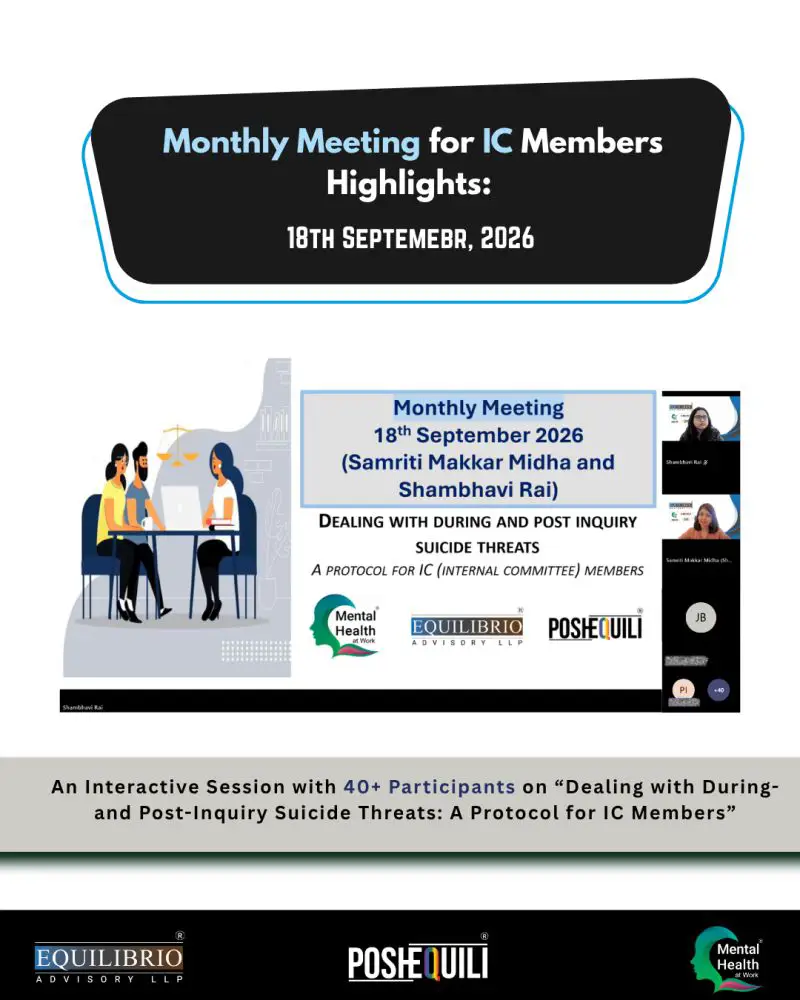
This month’s POSHequili Monthly Meeting brought IC members together for a nuanced conversation on “Dealing with During- and Post-Inquiry Suicide Threats: A Protocol for IC Members.” Facilitators Samriti Makkar Midha and Shambhavi Rai explored warning signs, immediate response, documentation, confidentiality, mental health support, duty of care, reintegration and retaliation risks.
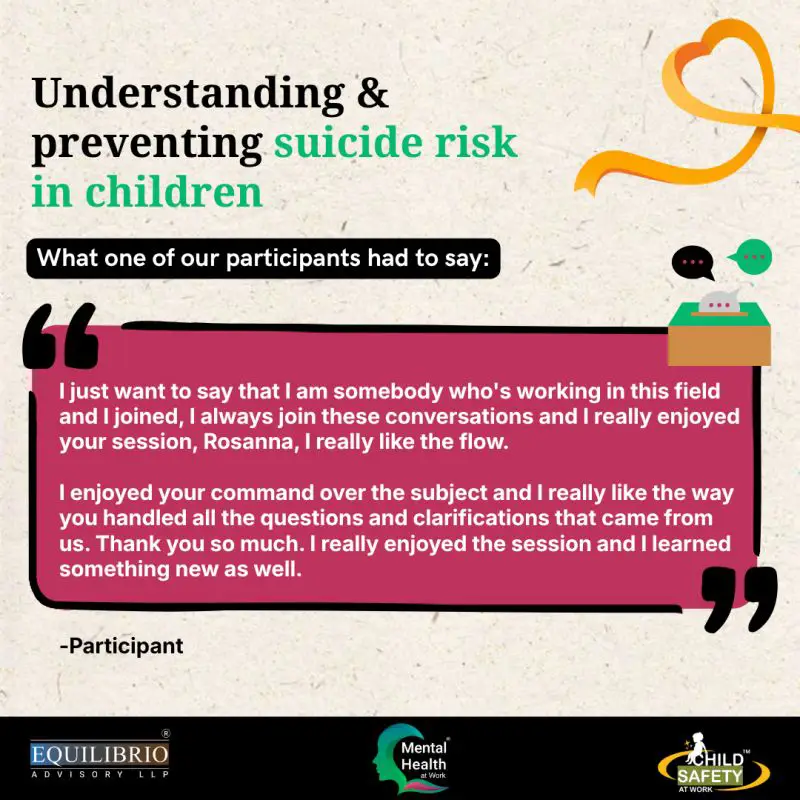
We recently held a workshop on Understanding and Preventing Suicide Risk in Children. What stayed with us was what participants brought back—their questions, reflections from classrooms and homes, and the feeling of being better equipped to have difficult conversations.
Sharing their feedback because it captures why this work matters.
Want this for your team?
Stay Current!
~ Spotlighting Landmark Judgments since passing of the Law!
I - LEGAL UPDATES

The Supreme Court observed that the Gender Sensitisation and Sexual Harassment Regulations, 2013, framed for the Supreme Court precincts, cannot be mechanically extended to women practising before High Courts, District Courts, Tribunals and other quasi-judicial authorities. The Court called for joint consultation among the parties to formulate a separate regulatory framework with wider coverage and asked the Bar Council of India to ascertain whether State Bar Councils already implement such regulations.

The Supreme Court held that a victim’s minority under the POCSO Act must be established strictly in accordance with Section 94 of the JJ Act. A Baptismal Certificate, unsupported by prescribed school, municipal or medical age evidence, was insufficient to establish minority. However, the Court found rape independently proved and held that conviction under Section 376 IPC could be sustained despite absence of a separate charge, since the accused had adequate notice and no failure of justice was caused.
The Supreme Court, while reviewing compliance with its directions on menstrual hygiene in schools, revised the prescribed standard for sanitary napkins from oxo-biodegradable products to biodegradable, biocompatible and compostable sanitary napkins complying with ISO 17088 read with IS 5405. The Court also directed surprise inspections by District Education Officers, anonymous student feedback and gap-based reporting, emphasising that mere policies or statistical claims do not establish effective implementation.
II - Exploring Intersections
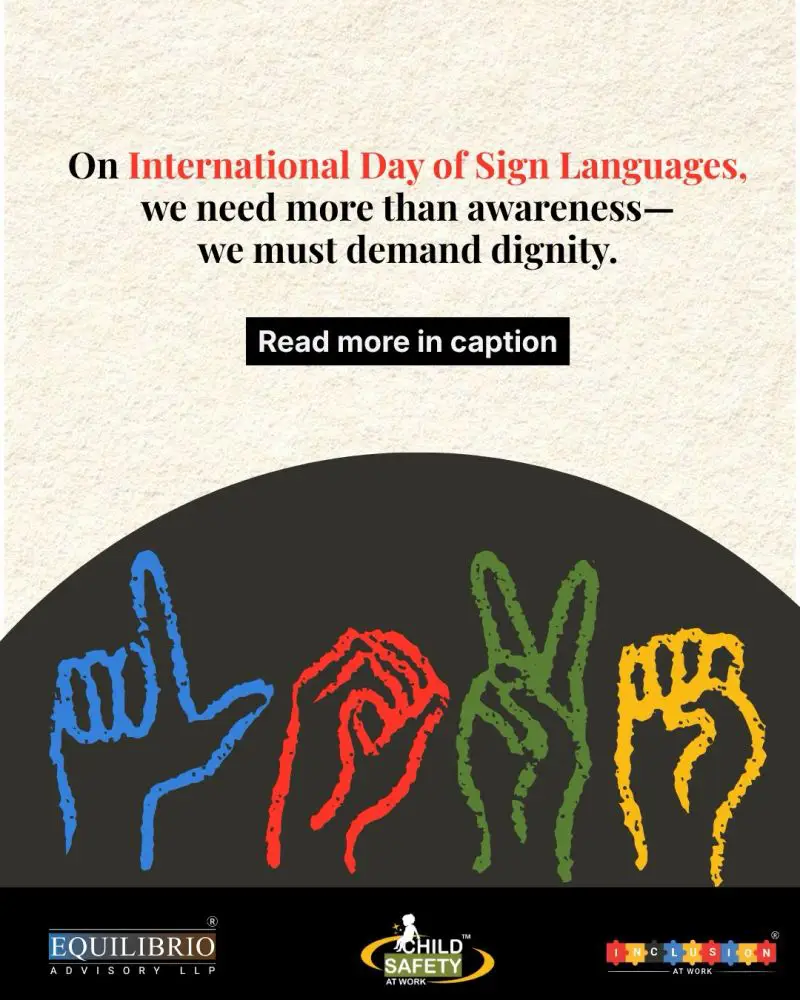
On International Day of Sign Languages, we’re reminded that sign languages are not just communication tools they are fundamental human rights. Recent protests across schools for deaf students in India have highlighted systemic gaps in infrastructure, staffing and inclusion. It’s time to move beyond compliance towards equitable access, dignity and meaningful inclusion.
Engage with us!
Here's your weekly food for thought through a Fun Fact or Quiz.
Did you know that 47-year-old Ramabai Ranveer recently won a 3km race while running barefoot, all to afford her daughter’s study materials? A widow working in agriculture to support her children’s dreams of government service, Ramabai’s determination highlights a profound systemic inequity: education is often touted as a pathway out of poverty, yet the costs of books and coaching remain significant barriers for families already struggling to survive. While her story eventually prompted a 51,000 INR grant from the Chief Justice of India after going viral, it raises a critical question about fairness.
How can we measure “merit” when some students have years of funded preparation while others must race barefoot just to afford their next textbook? Access to opportunity should be a right, not a reward for surviving extreme hardship or capturing public attention. We must advocate for infrastructures that provide families the security they need without requiring viral moments for basic support.

Have a burning question about POSH? Maybe Mental Health at Work, Child safety or DEI&B strategies? Drop us an email with your query and we would love to answer it, in all seriousness.
Curious Cat:
What is finsexuality?
Answer:
Finsexuality is a sexual orientation defined by an attraction specifically to feminine expression, regardless of the other person’s gender or biological sex. Unlike traditional terms like heterosexual or homosexual that center on gender categories, finsexuality focuses on the presentation of femininity including traits, style, mannerisms, and energy. A finsexual individual may be attracted to cis women, trans women, non-binary people, or men, provided they express a feminine presentation.
Emerging from LGBTQIA+ online spaces around 2014, this orientation highlights how attraction is often more fluid and nuanced than binary labels suggest. By centering expression over anatomy, finsexuality offers a vital vocabulary for those whose desires are rooted in the aesthetic and energetic qualities of femininity, affirming that attraction is a diverse experience that transcends conventional gendered expectations.

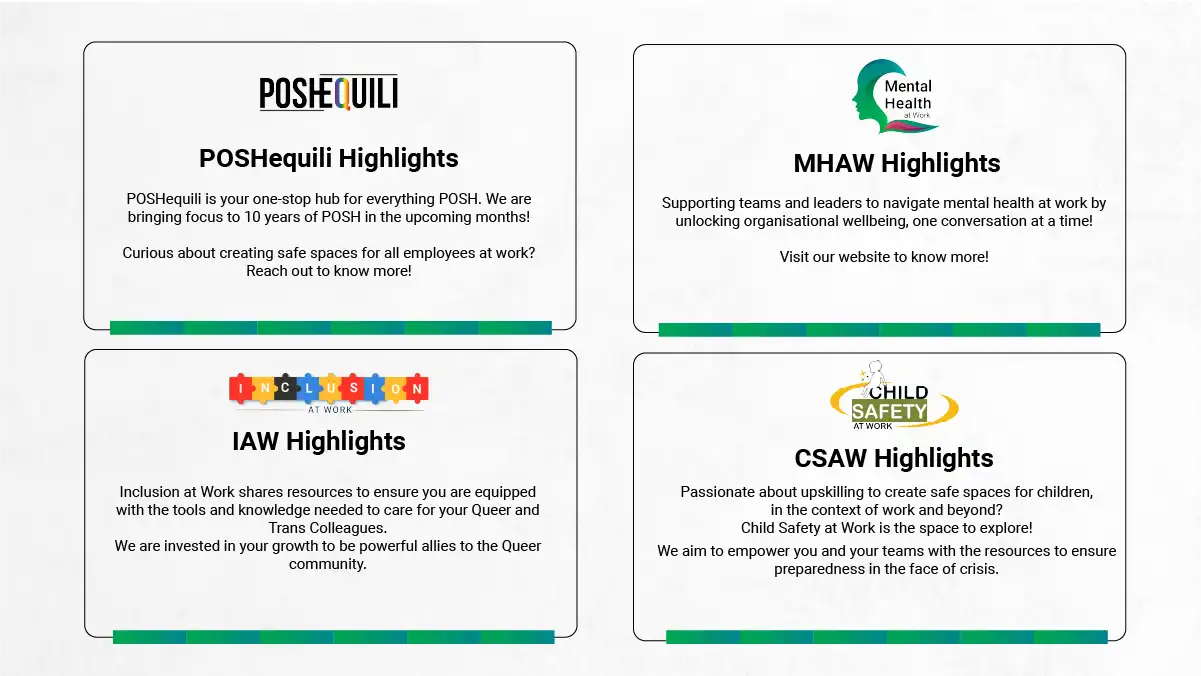
Here’s all the tools you need to build safe and equitable workspaces!
Drop us a Hey, to get started!